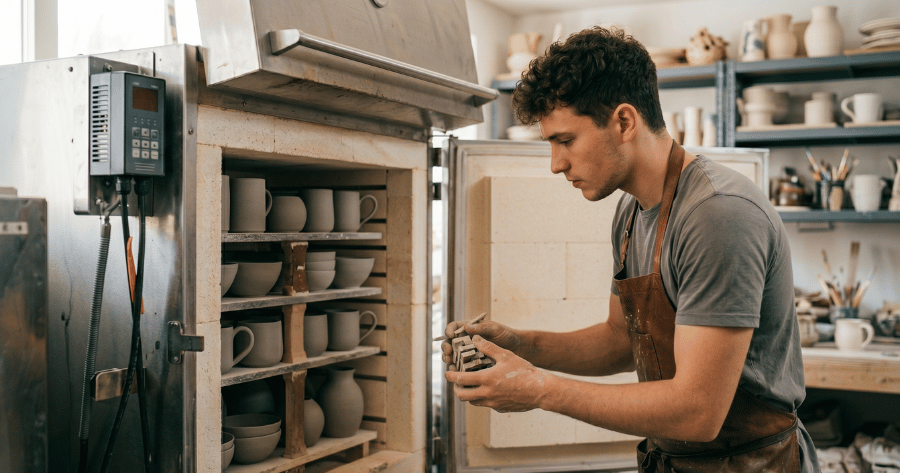
A piece made from raw clay normally goes through the kiln twice, and the two firings do completely different jobs. When I started out I had a kiln and a vague sense of "fire it, glaze it, fire it again," which got me through exactly until the first piece cracked. So here's the plain version: what a bisque firing actually does, what a glaze firing does, the cones and temperatures involved, and why the order is the way it is.
One note before the numbers. The cones and temperatures below are typical ranges, not rules. Your clay body and your glazes each come with a recommended firing range printed on the bag or jar, and that always wins. When the chart and the manufacturer disagree, follow the manufacturer.
One important exception up front: paint-your-own-pottery (PYOP) studios don't do the bisque firing at all. You buy ready-made bisqueware — those plain white mugs, plates and figurines — already bisque fired by the supplier. Customers paint it, you dip it in clear glaze, and you run a single firing in-house: the glaze firing. That's the whole PYOP cycle. The bisque half of this guide is really about studios that work from raw clay, but it's still worth understanding, because it explains why your blanks drink up paint the way they do — and the glaze-firing half is the one that matters for your kiln day.
On this page
The three states: greenware, bisque, glazed
It helps to name the three states a piece passes through:
- Greenware — clay that's been formed and dried but never fired. It's fragile, still chemically and physically holds water, and will dissolve if it gets wet again.
- Bisque — greenware after its first firing. Now a true, permanent ceramic: hard, durable enough to handle, but still porous.
- Glazed — bisque that's had glaze applied and been fired a second time, fusing the glaze into a glassy, waterproof surface.
Bisque firing: the first firing
The bisque firing is what turns fragile greenware into ceramic. As the kiln heats, the last of the water is driven off and the clay particles begin to sinter — bonding together into a hard, stable material that won't return to mud. Crucially, bisqueware stays porous, and that porosity is the whole point: it's strong enough to handle and decorate, and it drinks up glaze evenly in the next step.
Clay studios commonly bisque fire to around cone 04 (roughly 1945°F / 1060°C), though plenty work somewhere in the cone 06 to 04 range depending on the clay and what comes next. (If you run a PYOP studio, this is the firing your supplier has already done to the blanks you buy — you don't do it yourself.) The early part of the firing is slow on purpose — a phase called candling gently drives off remaining moisture so trapped steam doesn't crack or explode a piece. Load bisque firings so pieces can touch (they don't have glaze to fuse them yet), which lets you pack the kiln efficiently.
Glaze firing: the second firing
Once a piece is bisqued and decorated, the glaze firing melts the glaze into a smooth, glassy coat and brings the clay closer to its mature, vitrified state. The target temperature here depends entirely on the clay and glaze you're using:
- Low-fire — about cone 06 to 04. This is where most paint-your-own work and many bright commercial glazes live.
- Mid-fire — about cone 5 to 6 (roughly 2167–2232°F / 1186–1222°C). Popular for stoneware in studios and classes.
- High-fire — about cone 9 to 10 (roughly 2300°F / 1260°C and up). Traditional stoneware and porcelain territory.
The golden rule of glaze firing: glaze must not touch the kiln shelves. Molten glaze is essentially glass, and a glazed foot resting on a shelf will fuse to it permanently. Wax the foot, leave a dry margin, use kiln wash on your shelves, and use stilts where appropriate. Pieces also can't touch each other in a glaze firing for the same reason.
Why bisque first? (and what about once-firing)
Bisquing first gives you two big advantages: the porous bisque absorbs glaze evenly and quickly, and a sturdy bisqued piece is far easier and safer to handle while you decorate than crumbly greenware. It's possible to skip the bisque and apply glaze directly to greenware — this is called once-firing or raw glazing — but it's more advanced and more failure-prone, since wet glaze on dry greenware invites cracking. For studios working from raw clay, the two-firing route is the reliable default. Paint-your-own studios don't face this choice at all: the bisque firing is already done for them, so they only ever run the glaze firing.
Quick reference
| Firing | Purpose | Typical cone | Typical temp |
|---|---|---|---|
| Bisque | Harden greenware into porous, handleable ceramic | ~06–04 | ~1830–1945°F |
| Glaze (low-fire) | Melt glaze to a glassy surface; PYOP & bright glazes | ~06–04 | ~1830–1945°F |
| Glaze (mid-fire) | Mature stoneware; durable studio work | ~5–6 | ~2167–2232°F |
| Glaze (high-fire) | Vitrify stoneware & porcelain | ~9–10 | ~2300°F+ |
Approximate, for orientation only. Always fire to the cone your specific clay and glaze recommend.
Tracking pieces through firing
Here's where firing becomes an operations problem as well as a ceramics one. Every piece is separated from its owner for days at a time. In a clay studio that happens twice — once while it waits for the bisque, once while it waits for the glaze firing and pickup. In a PYOP studio it happens once, between the customer painting their blank and collecting it after the glaze firing. Either way, those waits are exactly when pieces get muddled, mislabelled, or quietly lost on a shelf.
A clear per-stage workflow solves this: each piece carries a status that maps to a shelf and, where it matters, a customer message. A clay studio might use greenware → bisqued → glazed → ready; a PYOP studio might use painted → glaze fired → ready. With ClayTrack you move a piece to the next stage with one tap, and the customer is told automatically when their work has been fired and again when it's ready to collect — by email or SMS, under your studio's branding. The firing stays a ceramics question; the "whose is this and where is it?" question stops being one at all.
Frequently asked questions
What temperature is a bisque firing?
Most studios bisque to around cone 04 (roughly 1945°F / 1060°C), though many work in the cone 06–04 range. The exact target depends on your clay body, so follow the manufacturer's recommendation.
Can you glaze pottery without bisque firing first?
Yes — it's called once-firing or raw glazing, where glaze goes onto greenware and the piece is fired once. It works but is more advanced and riskier, so studios working from raw clay almost always bisque first: porous bisque is sturdier to handle and absorbs glaze evenly. Paint-your-own studios sidestep the question entirely — they buy ware that's already been bisque fired and only do the glaze firing.
What cone is used for paint-your-own pottery?
Low-fire, and the studio only does one of the two firings. The blanks you buy have typically been bisque fired to around cone 04 by the supplier. After customers paint, you run a single glaze firing — usually around cone 06 — to set the underglaze and clear glaze. Check the cone printed on your glazes, as that determines your firing.