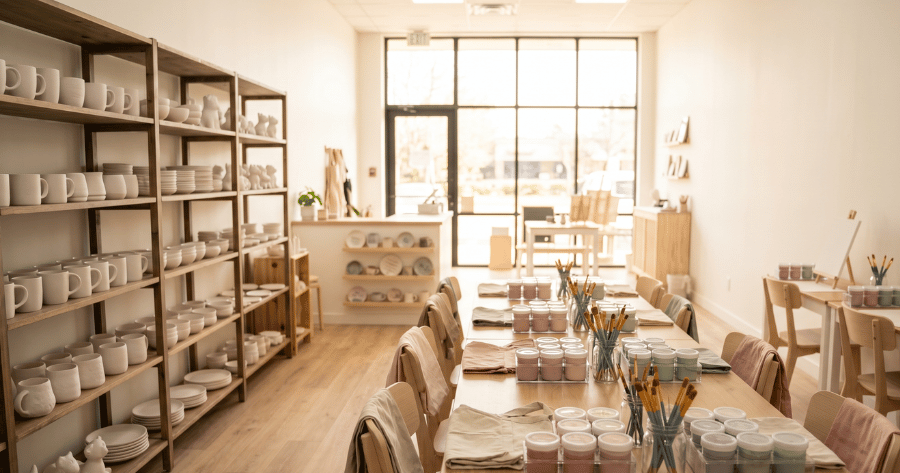
A paint-your-own-pottery studio is one of the most approachable creative businesses you can open: you don't need to be a master potter, the atmosphere is warm and social, and customers happily pay for an experience as much as an object. It's also a real business with real kit, real overhead and a handful of operational traps that catch first-timers — I walked into most of them myself when we set up. So this is the playbook I'd hand my past self: what it costs, what you'll buy, how to lay the room out, how to price, and the systems that keep it all running once the doors open.
One caveat on the numbers below: they're industry rules of thumb, US-oriented, and yours will move with your location, your space and your timing. Treat them as a planning frame, not a quote.
On this page
What a paint-your-own-pottery studio actually is
The model is simple and that's its genius. A customer comes in, chooses a bisque piece — a mug, a bowl, a figurine — and paints it with underglazes at a table. They leave it with you; you dip it in clear glaze and fire it; they come back in a few days to collect a finished, food-safe piece they made themselves. You're selling three things at once: the object, the experience of making it, and the time spent in your space.
The money comes from a mix of walk-ins, birthday and group parties, school and corporate events, and repeat visitors. Parties and events are where the margins are best, so a studio that's set up to host them well tends to outperform one that only serves walk-ins.
Is it the right business for you?
A quick, honest reality check before you spend anything. PYOP rewards people who enjoy hospitality as much as craft — you'll spend more time helping nervous first-timers, running parties and managing a shop floor than you will making your own work. The first three to six months are a steep learning curve of dipping, firing, pricing, serving and hosting, all at once. If the idea of a busy, social, slightly messy room of happy customers energises you, you'll thrive. If you mainly want quiet studio time to throw pots, a production or teaching studio may suit you better.
What it costs to start
Pottery-business consultants commonly frame startup packages (the kit and setup, not the whole business) in rough tiers. The figures below are ballpark averages from a PYOP startup consultant, rounded; a real quote depends on your location, square footage and what you already own:
| Studio type | Typical package | Good for |
|---|---|---|
| Home-based | ~$6,000–7,000 | Testing the waters, parties, markets |
| Small studio | ~$10,000 | A modest storefront |
| Large studio | ~$15,000 | A busy retail location |
| Serious build-out | ~$20,000+ | High-traffic, multi-offering studio |
Rounded averages for the setup package only; rent, fit-out, deposits and working capital sit on top. Source: Open Art Studio PYOP startup packages.
Those packages are only part of the picture. On top of the setup, budget for the line items that make a storefront real:
- Kiln(s) and a proper ventilation system — a glazing/painting area with decent ventilation alone can run roughly $1,000–$4,000.
- Bisque inventory — your opening range of paintable pieces.
- Underglazes, clear glaze, brushes, sponges, stamps.
- Furniture — tables, chairs, display shelving, ware carts.
- Point of sale, signage, and a piece-tracking system.
- Rent deposit and fit-out for your space.
Then the single most-skipped item: working capital. Set aside roughly 20–25% of your total startup budget as a cushion to cover rent, wages and restocking through the first quiet months before the studio sustains itself. Studios that skip this are the ones that get squeezed right when they should be finding their feet.
On the upside: revenue varies enormously by location and footfall. Industry write-ups put a PYOP studio's monthly takings anywhere from a couple of thousand dollars to roughly $30,000, with net margins commonly cited in the 20–40% range once you're established (BusinessDojo, FinancialModel). The honest takeaway isn't a number, it's a pattern: year one is usually about building momentum, and many owners reinvest early profits straight into another kiln, more inventory or a new offering rather than drawing a salary. Treat any single figure you read (including these) as a loose guide, not a forecast.
Equipment & supplies
The non-negotiables:
- A kiln (often two as you grow) sized to your expected volume. Firing in-house is what makes the few-days turnaround possible.
- Ventilation for the kiln and the glazing area — a safety essential, not an optional extra.
- Bisqueware in a range of price points and occasions, refreshed seasonally.
- Underglazes and a reliable food-safe clear glaze, plus brushes, sponges and decorating tools.
- Tables, seating and ware carts to move and store work between stages.
Buy your opening bisque range a little conservatively — you'll learn fast what your customers actually reach for, and you don't want shelves of slow movers tying up cash in month one.
Finding and laying out a space
For a PYOP studio, location is marketing. Prioritise foot traffic and visibility — near family attractions, cafes, or in a walkable retail strip — over cheap rent in a quiet spot. On square footage, you need room for painting tables, a glazing/wet area, kiln(s) with clearance and ventilation, bisque display, and a counter, without it feeling cramped on a busy Saturday.
Lay the room out by following a piece's journey: customers choose bisque near the entrance, paint at well-lit tables, and hand work to a counter; from there it flows to the wet/glazing area, then the kiln, then onto clearly labelled pickup shelves. A logical flow keeps staff efficient and keeps finished pieces from piling up in the wrong place — which is exactly where they get lost.
Pricing your pieces
Pricing makes or breaks PYOP margins. The industry shorthand is to price a piece at roughly seven times its bisque cost, which targets keeping your cost of goods around 15% of the sale price — then layer a per-person or per-piece studio fee on top, depending on your model. It's a big topic with real money at stake, so we've given it its own guide: how to price paint-your-own-pottery, with worked examples.
The systems you'll run on
Here's the part new owners underestimate. Once you're open, the work isn't painting — it's operations. Every day you take in pieces from dozens of customers, fire them on your schedule, and hand them back days later. Get that flow wrong and you get the classic PYOP failure mode: shelves of finished pieces nobody's collected, customers ringing to ask if theirs is ready, and the occasional piece that simply can't be found.
So treat your operational stack as seriously as your kiln:
- Registration & piece tracking — link every piece to a customer the moment it's handed over, and track it through each stage. This is the backbone; losing track of pieces is the number-one operational headache in this business.
- Customer notifications — tell people automatically when their piece is fired and when it's ready, and remind them to collect. Reminders by text get opened; reminders that get opened clear your shelves.
- Point of sale and bookkeeping — for walk-in sales, studio fees and parties.
- Party & booking handling — your highest-margin work deserves a smooth booking flow.
This is exactly the gap ClayTrack was built to fill — by a working pottery studio owner, for studios like the one you're about to open. Customers scan a QR code and register their pieces with a photo in about 30 seconds, no app and no account to create. You move each piece through your own custom workflow with one tap, and ClayTrack notifies customers by email or SMS, under your studio's branding, all the way to pickup. It deliberately does one job — tracking and notifying — and does it simply, so it's running smoothly on day one instead of being another thing to learn. You can compare it with the other tools here.
Getting your first customers
Open with momentum, don't wait for it. A few reliable channels for a new PYOP studio:
- Local social media — photogenic finished pieces and happy painters are made for Instagram and local Facebook groups.
- Parties and events — actively sell birthday, hen, team and school bookings from day one; they fill quiet weekdays and bring groups who become repeat walk-ins.
- Schools and community groups — field trips, fundraisers and holiday camps.
- A grand opening — a launch weekend with a small offer gets first feet through the door and first photos online.
Then make repeat visits effortless: the easier it is for a delighted first-timer to book again or bring a group, the faster your studio compounds.
A realistic opening timeline
From signed lease to open doors, plan for several months — commonly three to nine, depending on the site and your budget. A rough sequence:
- Months 1–2: business plan, budget, and secure your space.
- Months 2–4: fit-out, install kiln and ventilation, order furniture and opening bisque inventory.
- Month 4–5: set up POS, piece-tracking and notifications, pricing, and your party packages.
- Final weeks: soft launch with friends and family to test your flow, then your grand opening.
Open before everything is perfect — a soft launch will teach you more about your real workflow than another month of planning ever could. Get the operational backbone in early, and your opening day is exciting instead of chaotic.
Frequently asked questions
How much does it cost to open a PYOP studio?
It depends heavily on size and location. As a rough guide, one PYOP consultant prices setup packages at roughly $6,000–7,000 for a home-based studio, ~$10,000 for a small one, ~$15,000 for a large one and $20,000+ for a serious build-out (Open Art Studio). That's just the kit — rent, fit-out, deposits and working capital sit on top, so budget well beyond the headline figure.
Is a paint-your-own-pottery studio profitable?
It can be, but the numbers vary a lot. Industry write-ups put monthly revenue anywhere from a couple of thousand dollars to around $30,000, with net margins commonly cited around 20–40% once established (BusinessDojo). Most owners treat year one as building momentum and reinvest early profits. It comes down to rent, foot traffic, pricing and how well you run parties and repeat visits.
Do I need my own kiln?
Almost always yes — in-house firing is what enables the few-days turnaround the model depends on. That means at least one kiln and proper ventilation.
How long does it take to open?
Typically three to nine months, covering space, fit-out, kiln and ventilation, inventory, systems and marketing.